Appearance
Kubernetes Architecture
To quickly demystify Kubernetes, let's have a look at the Kubernetes Architecture graphic, which shows a high-level architecture diagram of the system components.
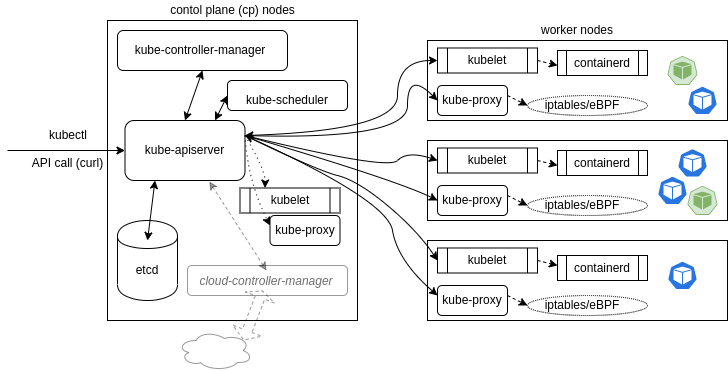
In its simplest form, Kubernetes is made of one or more central managers (aka masters) and worker nodes (we will see in a follow-on chapter how you can actually run everything on a single node for testing purposes). The manager runs an API server, a scheduler, various operators and a datastore to keep the state of the cluster, container settings, and the networking configuration.
Kubernetes exposes an API via the API server: you can communicate with the API using a local client called kubectl or you can write your own client. The kube-scheduler sees the API requests for running a new container and finds a suitable node to run that container. Each node in the cluster runs two components: kubelet and kube-proxy. The kubelet systemd service receives spec information for container configuration, downloads and manages any necessary resources and works with the container engine on the local node to ensure the container runs or is restarted upon failure. The kube-proxy pod creates and manages local firewall rules and networking configuration to expose containers on the network.